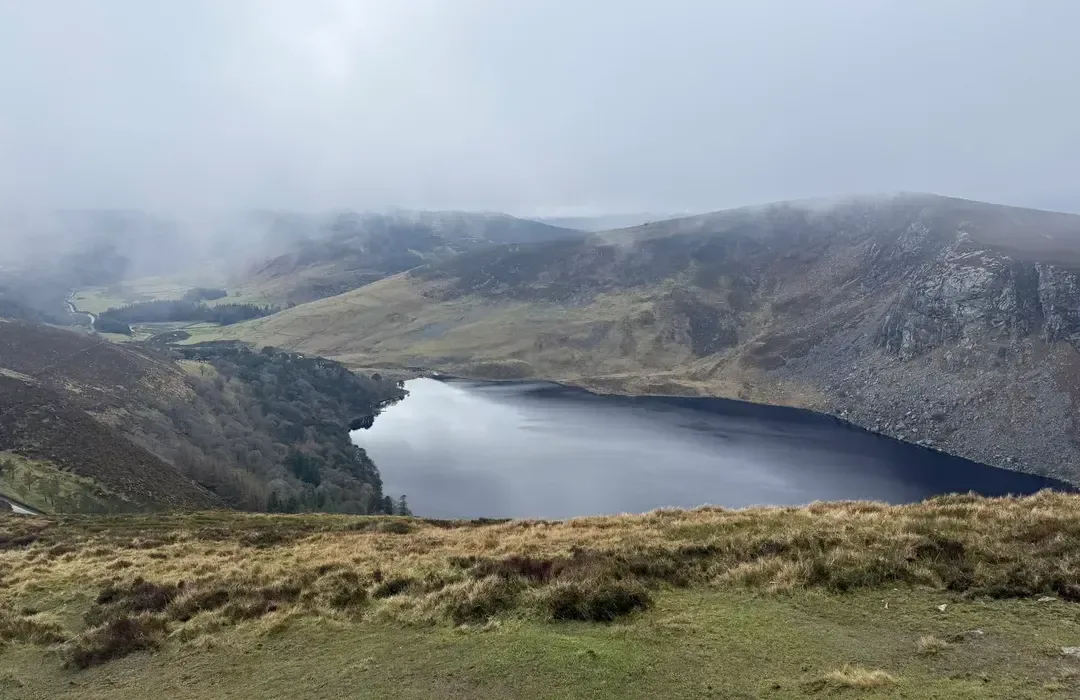
Welcome to Stage Two of the Wicklow Way. You are beginning your journey today in the village of Shillelagh, and you will end it approximately eighteen kilometres and five and a half hours later in the market town of Tinahely. This is the second stage of Ireland's oldest long-distance walking route, and in many ways, one of the most characterful. The terrain is mixed — forest tracks, country lanes, open farmland, and the remnants of the old estate walls of the Fitzwilliam family. The climbs are modest but sustained. The pace, if you let it, is perfect.
Before you set out from Shillelagh, a word on the village itself. The name Shillelagh comes from the Irish Síol Éalaigh — the seed of Éalaigh, a legendary early king of this region. For centuries, the village sat at the heart of what was called the Shillelagh Country — one of the great oak forest regions of eastern Ireland, and the source of the famous shillelagh cudgel, the stout walking stick made from blackthorn or oak, which became, in the nineteenth century, both a symbol of Irish identity and a genuine fighting weapon in the faction fights of the countryside.
The village itself is a Fitzwilliam estate village, planned in the late eighteenth century, with a small square, a Church of Ireland church, a terrace of nineteenth-century houses, a pub or two, and — at its southern edge — the entrance gates to the great demesne of Coollattin, the Fitzwilliam family seat. Coollattin House, a large Georgian mansion, survives today as a private home and golf club. The gardens are occasionally open to the public. The estate was, for over two centuries, one of the largest private landholdings in Ireland.
Set off north, following the waymarks. The Wicklow Way is marked throughout with a yellow walking-man symbol on wooden posts. You cannot get lost for long. The first section takes you along quiet country lanes out of the village and into a stretch of agricultural land — small fields, mixed stock, plenty of hedgerow. This is typical south Wicklow landscape: not the dramatic uplands of Glendalough or Djouce, but the softer, more populous lowland that has been actively farmed for centuries.
After about three kilometres, the route turns onto a forestry track and climbs gradually into a stretch of commercial Sitka spruce plantation. The path here is wide, well-surfaced, and enclosed by forest on both sides. Look, as you walk, for the small oak saplings appearing along the verges — part of a long-term replanting programme to restore some of the native broadleaf woodland that once dominated these hills.
Listen, too. These forests are home to red squirrels, which were reintroduced to Wicklow after near-extinction in the twentieth century. They are shy and quick — you're more likely to see a falling pine cone than the squirrel that dropped it. Ravens call from the canopy. In summer, cuckoos. In spring, blackbirds, robins, wrens, and — if you are extraordinarily lucky — a woodcock flushing from cover.
At around kilometre six, the path emerges briefly from the forest and offers a view east across the Derry valley. The Derry River, a tributary of the Slaney, flows south-east from here towards the sea at Wexford Harbour. On a clear day, you can see the long, low ridge of the Blackstairs Mountains in the distance — the border country between Wicklow and Wexford.
The path re-enters forest and continues north. Around kilometre nine you come to the remnants of an old estate wall — dry-stone, heavily mossed, and running through the forest for about a kilometre. This is the boundary of the Coollattin estate. When the Fitzwilliams sold most of their Irish lands in the 1970s, the wall was left intact, and today it is being slowly reclaimed by the forest that grew up around it. Walk along beside it. Notice the occasional gateway, the foundation of a former gamekeeper's cottage. The estate that ran these lands is gone. The wall remains.
You descend now, gradually, towards the Derry valley proper. The forest opens up, and the path crosses a small stone bridge over a tributary stream. This is an important moment on the stage — the halfway point, roughly, and a good place for a break. There's a grassy bank near the bridge, typically out of the wind, and a small cairn where walkers have over the years stacked stones as a kind of memorial or offering. Add one if you want to. Take one only if you're going to return it.
From the bridge, the path climbs again, over a modest ridge, and then descends steadily for several kilometres down towards Tinahely. The descent is one of the most pleasant stretches of the whole Wicklow Way — wooded in its upper part, opening into pasture in its lower part, with the spire of Tinahely's Church of the Assumption appearing in the valley ahead.
A word on the landscape you are walking through. This is the heart of south Wicklow — a quiet, thinly-populated, deeply traditional farming country where families have lived on the same land for generations. You will see few other walkers on this stage, and the ones you do see will typically greet you with a nod or a hello. This is not a route that gets the volume of Glendalough. And that is a good thing.
A note on celebrity, because people sometimes ask. The well-known residents of County Wicklow — the singer-songwriter Chris de Burgh, the actor Daniel Day-Lewis, the broadcaster Pat Kenny, and many others — live primarily in the northern and eastern parts of the county, closer to Dublin. South Wicklow, the part you're walking through today, has a quieter celebrity. The late poet and broadcaster John O'Donohue often spent retreats in this region. The folk musicians Mick Hanly and Donal Lunny have both written songs about the Shillelagh country. The novelist Sebastian Barry has used south Wicklow landscapes in several of his books.
As you approach Tinahely, the path joins a narrow farm lane, crosses a small river, and drops you down into the edge of the village. The final kilometre runs along the banks of the Derry River, past the old fair green, and into Tinahely's triangular Square.
Tinahely. Population around seven hundred. An old Fitzwilliam estate village, planned in the late eighteenth century, with a handsome Georgian terrace running around a triangular square. The Courthouse, built in 1843, now operates as the Courthouse Arts Centre — one of the busiest small arts venues in the south-east, with a programme that runs from traditional Irish music through contemporary theatre to visual art. It is worth a visit regardless of your plans for the evening.
For accommodation tonight, Madeline's Guesthouse — a beautifully restored nineteenth-century building on Main Street — is a WalkWicklow Premium Partner and offers self-service coded entry, double and twin rooms, and is a three-minute walk from the Square. For food, Hanlon's, the Bridge Café, the Courthouse café, and one or two small restaurants cater to walkers. For a pint, there are three pubs in town, each with its own regulars and character.
Stage Three of the Wicklow Way departs Tinahely tomorrow, heading north towards the village of Moyne. If your plan is to continue, confirm your accommodation for tomorrow night before you sleep — beds along the Way can fill up fast in summer.
Thank you for walking with us today. Stage Two is one of the quiet treasures of the Wicklow Way. You've earned your dinner.